Every trekker who embarks on the classic journey to Everest Base Camp must pay a specific, unavoidable toll before they are granted entry to the high Himalayas. It is not paid in rupees, nor is it extracted by a border guard. It is paid in breath, in burning quadriceps, and in the slow, methodical crushing of the ego. This toll is the ascent of Namche Hill.
For hours, the path from the suspension bridge over the Dudh Koshi river below is a steep, unrelenting, switchbacking staircase of jagged stone and dirt. As you climb, the lush, lower-altitude forests of blue pine and rhododendron begin to thin. The air grows noticeably thinner, turning every step into a minor cardiovascular event. You stop frequently, bent over your trekking poles, gasping in the rarefied atmosphere, wondering if the physical suffering is worth the hype.
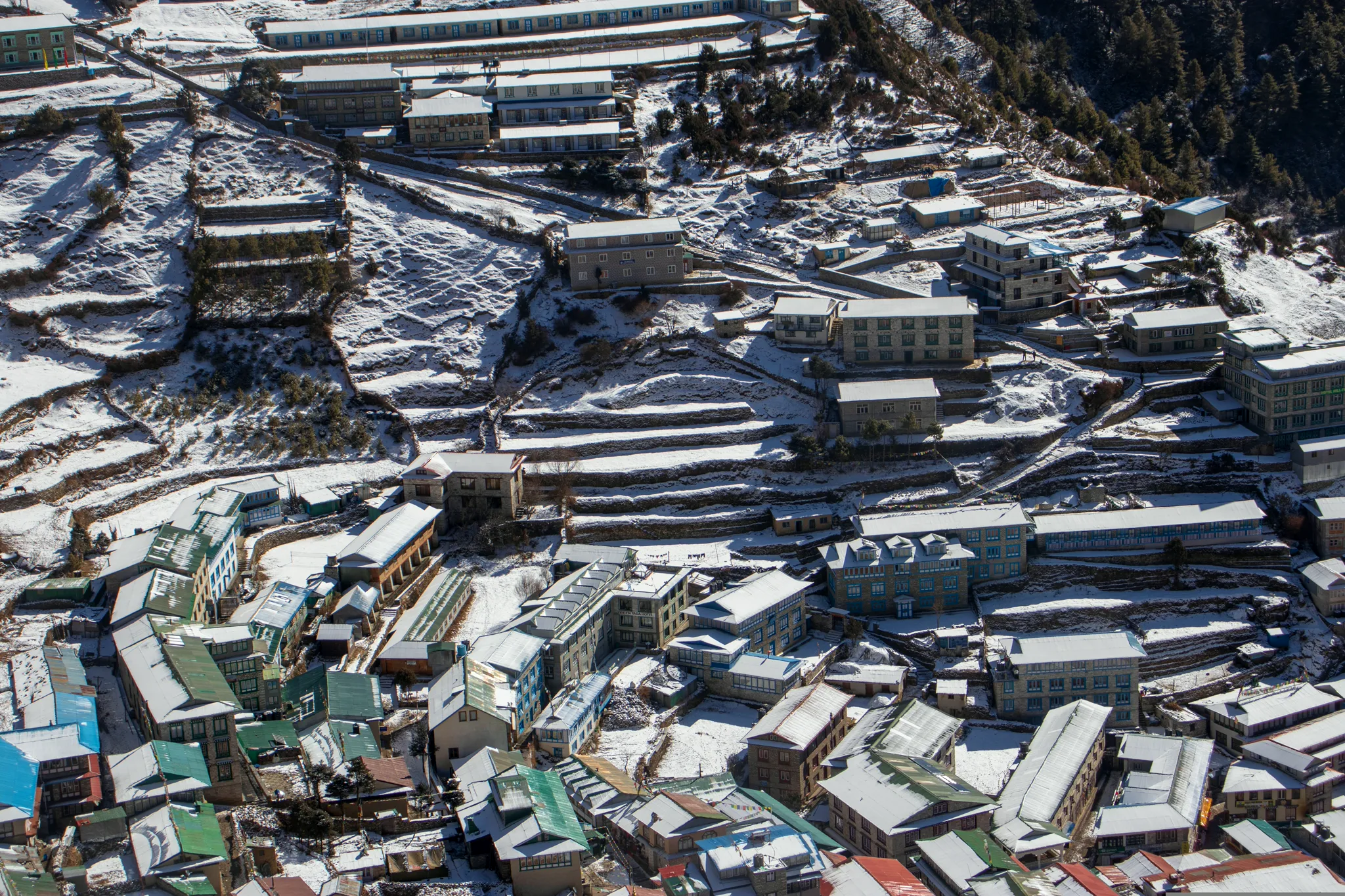
And then, finally, you crest the final ridge. The pain immediately evaporates, replaced by a sweeping, cinematic revelation. There, nestled impossibly into a natural, horseshoe-shaped bowl carved out of the mountain flank, lies Namche Bazaar.
The Amphitheater of the Khumbu
At 3,440 meters above sea level, Namche is the unofficial capital of the Khumbu region, the economic and cultural heartbeat of the Everest area. Looking down at it from the top of the hill, it resembles a natural amphitheater. The buildings are not built vertically, like in the cities of the valley, but terraced into the steep hillside, a dense cluster of flat-roofed, stone-walled houses painted in muted tones of earth, grey, and faded blue. It looks less like a town and more like a high-altitude fortress, a human settlement clinging stubbornly to the side of the world.
Stepping into the main square of Namche for the first time is a surreal experience. After days of walking through remote farming villages where the amenities consist of a single wooden bench and a pot of instant noodles, Namche feels like arriving in a bustling metropolis. But it is a metropolis governed by the laws of extreme geography.
Contrasts in Thin Air
The town is a masterclass in contrasts, a place where ancient Tibetan Buddhist traditions collide head-on with the gritty, high-tech realities of modern alpinism. The central square is dominated by a large, flat open space where, historically, yak caravans from Tibet would trade salt and wool for Nepali rice and grain. Today, that same square might see a line of snorting, heavily laden pack animals waiting for their loads, while just a few feet away, a climber wearing a fifteen-thousand-dollar down suit is checking the weather forecast on a satellite-connected smartphone.
The architecture of Namche is distinctly Sherpa. The buildings are sturdy, designed to withstand the crushing weight of winter snows and the biting cold. But tucked beneath the stone eaves and beside the traditional, hand-carved wooden windows, you will find a surprisingly cosmopolitan array of businesses. Namche boasts the highest Irish pub in the world, bustling German bakeries pumping out the smell of fresh croissants and espresso, and high-end gear shops selling oxygen canisters, satellite phones, and thermal wear. It is a bizarre, wonderful anomaly: a slice of first-world consumerism transplanted into one of the most inhospitable environments on Earth.
Yet, despite the commercial veneer, the spiritual soul of the Himalayas remains unbroken in Namche. You cannot walk more than a few meters without encountering a mani wall, its ancient stones smoothed by centuries of passing hands, engraved with the Tibetan Buddhist mantra Om Mani Padme Hum. Prayer flags are strung in wild, tangled webs from every rooftop, snapping aggressively in the relentless mountain wind, constantly broadcasting their blessings across the valley. Above the town, perched on a ridge like a sentinel, sits the brightly colored Namche Monastery.
"It is in this forced idleness that Namche’s true magic is revealed. Stripped of the ability to rush, you begin to observe... You simply watch the world go by."
The Pause of Survival
The primary purpose of Namche Bazaar, however, is not commerce or sightseeing; it is survival. It is the universal acclimatization hub of the Everest region. Because of its altitude, almost every trekking itinerary mandates a two-night stay here before pushing higher into the Khumbu.
For many travelers, this mandatory rest day is initially frustrating. We are conditioned to measure the success of a trip by distance covered and milestones achieved. Being told to sit still and walk in circles around a village feels like a waste of time. But the body quickly dictates the terms. At 3,440 meters, the lack of oxygen exerts a heavy toll.
You watch the clouds roll down the valley like a slow, white tide, swallowing the lower villages before retreating back up the slopes. You watch the porters—often tiny, incredibly resilient men and women from the lower valleys—stride up the steepest hills with sixty kilograms of gear balanced on their backs, supported by a simple tump line across their foreheads. Their effortless strength puts your modern, lightweight hiking gear to shame.
The Roof of the World Revealed
The undeniable climax of the Namche experience, however, occurs an hour before dawn on your acclimatization day. You force yourself out of your warm sleeping bag into the freezing, pre-dawn dark, and begin the steep, one-hour climb out of the bowl to the Everest View Hotel.
There, rising impossibly high above the surrounding sea of minor peaks, is Mount Everest. It is not a solitary peak, but the crown jewel of an entire royal court. To its left stands the sleek, razor-sharp pyramid of Ama Dablam, widely considered the most beautiful mountain in the world. To its right, the massive, bulkier forms of Lhotse and Nuptse loom like dark guardians. As the first rays of the sun strike the summit of Everest, the snow turns a blinding, ethereal gold. In that singular moment, freezing and exhausted, you understand exactly why you climbed Namche Hill.
Leaving Namche Bazaar is a bittersweet transition. When you leave, you are leaving the last real vestige of civilization. Beyond Namche, the villages get smaller, the vegetation disappears entirely, the air gets thinner, and the landscape becomes starkly lunar. Navigating out of that horseshoe-shaped bowl, you step over the ultimate threshold into the raw wilderness of the upper Khumbu.
Expedition Essentials
Walk High, Sleep Low: Do not skip the acclimatization day. The hike to the Everest View Hotel (3,880m) and then sleeping back in Namche (3,440m) is critical for preventing acute mountain sickness.
The Last Luxuries: Namche is your last chance for reliable Wi-Fi, ATM machines, actual espresso, and quality gear replacement before pushing deeper into the austere upper Khumbu.