In the modern era of adventure travel, the mountaineering world has developed a singular, relentless obsession with superlatives. We covet the highest, the steepest, the most extreme. Because of this, the summit of Everest has been reduced to a crowded, highly commercialized traffic jam, and the trails of the Annapurna region are lined with espresso bars and luxury lodges. We have cataloged the Himalayas, boxed them up, and placed them neatly on the shelf of achievable tourist experiences.
But tucked away in the far eastern corner of Nepal, straddling the remote border with the Indian state of Sikkim, lies a mountain that fiercely resists this domestication. Kanchenjunga. At 8,586 meters, it is the third-highest peak on the planet, a truly staggering monolith of rock and ice. Yet, ask the average traveler on the streets of Kathmandu about their trekking plans, and Kanchenjunga will rarely cross their lips. It remains the overlooked titan, the sleeping giant of the Himalayas, and for those few who make the arduous journey to its base, it offers arguably the most profound wilderness experience left in Nepal.
The Fortress of Ice
The name Kanchenjunga translates from Tibetan as "The Five Treasures of Snow," referring to its five distinct summits. But to understand Kanchenjunga, you must first understand its geography. It is not a single, perfectly pyramidal peak like Ama Dablam or Machhapuchhre. It is a massive, sprawling massif, a colossal mountain range unto itself. Its bulk is so immense, and its surrounding valleys so deeply cut, that it creates its own weather systems. It is a fortress of a mountain, guarded by raging, glacier-fed rivers, dense, leech-infested rhododendron forests, and a geographical isolation that naturally weeds out the casual tourist.
The journey to Kanchenjunga begins with a commitment to the extreme edges of the map. Unlike the Everest region, which boasts a thrilling but quick thirty-minute flight to a bustling airstrip, reaching Kanchenjunga is an exercise in endurance. It requires a full day’s drive from Kathmandu to the eastern lowlands, followed by a nerve-wracking, hair-raising flight in a tiny aircraft to the town of Bhadrapur, or an even longer, bone-rattling drive to the remote airstrip of Taplejung.
The Test of Patience
From the trailhead, the trek does not immediately grant you views of the mountain. Instead, it demands patience. For the first several days, you are submerged in the deep, subtropical valleys of the eastern Himalayas. The trails here are rough, often little more than mud slides carved into the hillsides by monsoon rains and passing mule trains. You walk through dense, primordial forests of oak and towering rhododendrons, past cascading waterfalls that plunge hundreds of feet into misty gorges. It is a lush, sweaty, visceral introduction to the raw, untamed east.
But it is precisely this grueling approach that makes the eventual revelation so devastatingly beautiful. Because you spend days walking in the shadow of the foothills, completely denied a view of the main stage, the moment the trail finally crests a high ridge and the veil is lifted, the emotional impact is staggering.
"This is not a mountain that has been conquered by the human spirit; it is a mountain that tolerates human presence. The silence here is not just the absence of noise; it is the presence of an overwhelming, ancient power."
A Confrontation with Scale
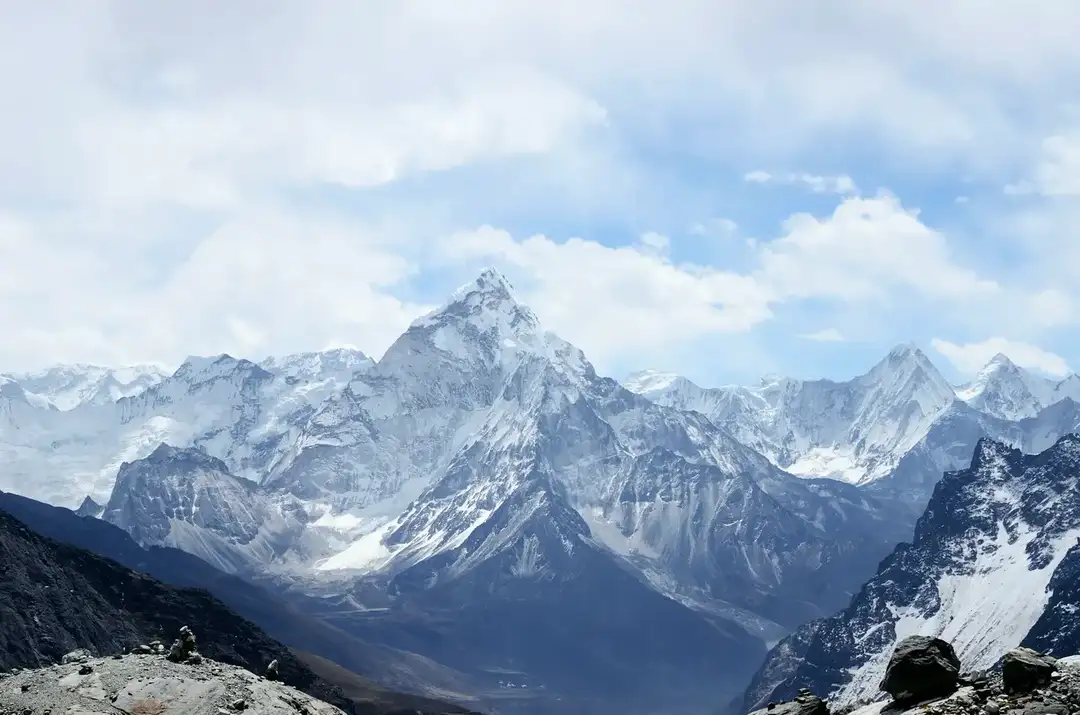
You do not just see Kanchenjunga; you are confronted by it. Because it is a massif, it dominates the entire northern horizon like a great, jagged wall of the earth's crust. The scale is nearly impossible for the human brain to comprehend. The south face of Kanchenjunga rises over three vertical kilometers from the Yalung Glacier to the summit—a drop so immense and sheer that it makes the skyscrapers of modern cities look like children’s toys. In the late afternoon light, the mountain turns a deep, bruised shade of purple and blue, its ridges sharp enough to cut the sky.
Standing on a high pass, looking across at that colossal wall of ice and rock, you feel a primordial sense of dread and awe.
The Heart of the Limbu People
What makes the Kanchenjunga trek truly transcendent, however, is not just the geology, but the profound cultural immersion. Because the region was completely closed to foreigners until the late 1980s, and because the infrastructure remains deliberately basic, the trail has been spared the homogenization of the west. There are no luxury bakeries here. The teahouses are simple, often unheated timber rooms, and the food is basic dal bhat, but the warmth of the hospitality is unmatched.
This region is the ancestral heartland of the Limbu people, an indigenous group with deep, ancient ties to the land. As you move higher into the valleys, Tibetan Buddhist influence begins to blend with Limbu animistic traditions. You walk through villages where life has changed little in centuries. You see farmers plowing fields with water buffalo, women weaving traditional textiles on backstrap looms, and children walking miles to school along precipitous trails. The prayer flags that strung across the valleys here do not feel like tourist props; they are frayed, weathered, and deeply integrated into the spiritual fabric of the community. The monasteries you pass are not museums, but active, smoky, incense-filled chambers where monks chant in voices that seem to resonate with the surrounding stone.
The Summit Spectacle
The climax of the journey is reaching Pangpema, the north base camp. The trail here ends abruptly at the edge of a massive, chaotic moraine of grey rock and ice. The Kanchenjunga Glacier stretches out before you, a frozen river of ice that has been slowly grinding its way down the mountain for millennia. The air is violently cold and incredibly thin. You are standing at the very edge of human habitation, looking directly up the throat of the third-highest point on Earth.
If you are fortunate enough to wake up clear at Pangpema, the sunrise is a spiritual event. As the first rays of the sun hit the highest point of the massif, the snow turns a blinding, ethereal gold. The light cascades down the five summits one by one, illuminating the intricate details of the ice falls and the sheer rock buttresses. It is a spectacle of such immense, indifferent beauty that it frequently brings trekkers to tears. It is a moment that strips away all the trivial anxieties of modern life, leaving you utterly humbled.
Leaving Kanchenjunga is a bittersweet experience. The trek back out requires retracing your steps down through the valleys, slowly re-acclimating to the heat, the noise, and eventually, the chaos of the modern world. But Kanchenjunga changes you. In a world where we have mapped every corner of the globe, where you can view the summit of Everest on a webcam from your couch, Kanchenjunga remains a wilderness of the imagination. It is a place that demands your physical effort, your sweat, and your time, and in return, it grants you a glimpse of the earth as it was before we tried to tame it. It is not just a trek; it is a pilgrimage to the last great frontier of the Himalayas, a reminder that there are still places on this planet vast enough to make us feel wonderfully, terrifyingly small.
Expedition Essentials
Autumn Exclusivity: Mid-October to late November offers the most stable weather and clearest views, completely avoiding the intense monsoon rains typical of eastern Nepal.
Remote & Rugged: Kanchenjunga remains a restricted area requiring a special permit, a registered guide, and a readiness for very basic, unheated teahouse accommodations.