When most people close their eyes and conjure an image of Nepal, their minds immediately drift upward. They picture the towering, icy sentinels of the Himalayas, the thin, crisp air of high-altitude passes, and the grueling, triumphant ascent toward base camp. Nepal is so deeply defined by its vertical extremes that the majority of travelers completely overlook its horizontal counterpart.
But strip away the down jackets, leave the trekking poles behind, and travel south from the mountains, descending through lush foothills into a world that is entirely different. This is the Terai, and tucked deep within it lies the country’s greatest wild frontier: Chitwan National Park.
The Primal Heartbeat
If the Himalayas are the spiritual and physical heights of Nepal, Chitwan is its raw, untamed, primal heartbeat. It is a place that trades altitude for attitude, replacing the silent serenity of the snow peaks with a humid, pulsating ecosystem where the law of the jungle is not just a cliché, but a daily reality.
The transition into Chitwan begins long before you reach the park gates. The pine forests are replaced by towering stands of sal trees, their straight, pale trunks rising like pillars into a canopy so thick it blocks out the midday sun. The landscape is carpeted in tall, razor-edged elephant grass that can easily grow taller than a man, forming an impenetrable, golden-green sea that sways in the hot wind.
The Living Mosaic of the Rapti
But the jungle does not hit you all at once; it seeps in slowly. My first morning in Chitwan began with the quiet, hypnotic dip of a wooden canoe into the Rapti River. Gliding silently down the murky, opaque water, the atmosphere is incredibly eerie. You are acutely aware that you are no longer at the top of the food chain.
Along the muddy banks lie mugger crocodiles. At first glance, they look exactly like floating logs, until you see the slow, deliberate blink of a cold, reptilian eye. Further down, you might spot the long, bizarre snout of a gharial breaking the surface—a living fossil perfectly adapted to these murky waters.
"This is not a sanitized zoo experience; this is immersion. You taste the dust in your teeth, feel the sweat pooling at the back of your neck, and smell the rich, earthy scent of decaying leaf litter."
The Ghosts of the Forest
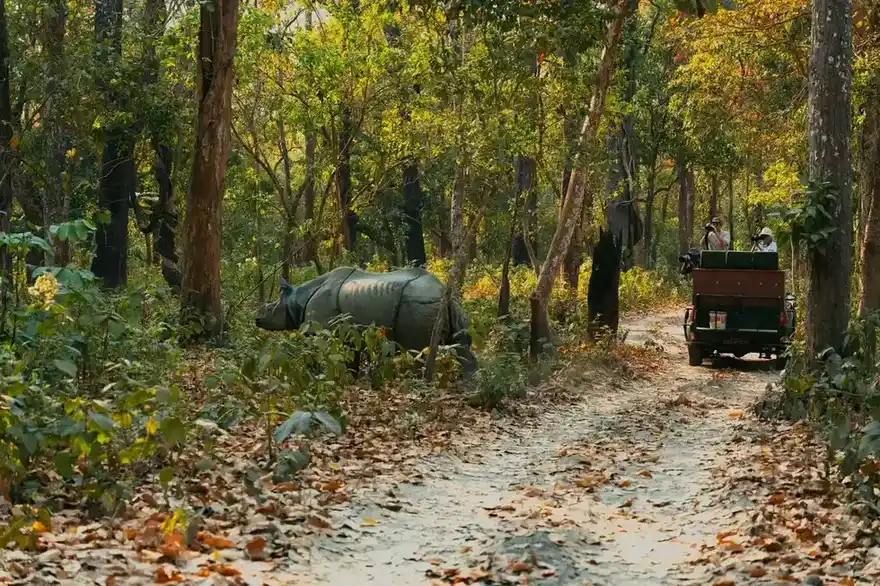
Chitwan is home to a healthy population of Royal Bengal Tigers, but they are the ultimate ghosts of the forest. They do not want to be seen. The jeep ride becomes an exercise in tension and heightened awareness. Your guide stands in the front, scanning the trail for pugmarks, analyzing the freshness of a scrape on a tree trunk.
If a tiger is moving, the forest announces it. You listen for the sharp, explosive bark of the barking deer, or the furious, guttural coughing of a hanuman langur monkey. When these alarm calls go up, the engine cuts. The silence that follows is deafening. Everyone in the vehicle holds their breath, hoping to catch a flash of amber and black.
Armor of the Ages
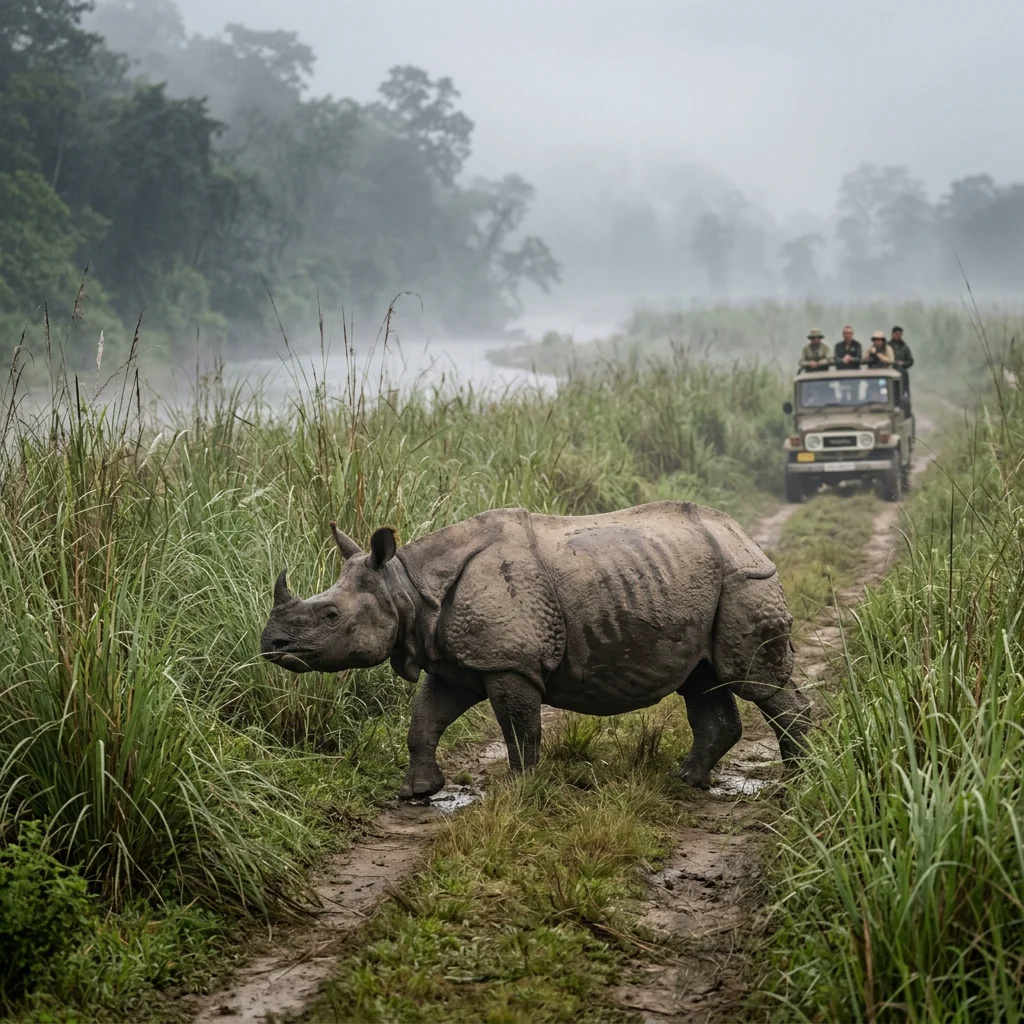
What Chitwan lacks in tiger sightings, it more than makes up for in sheer, undeniable megafauna. The absolute monarch is the Greater One-Horned Rhinoceros. They are biological masterpieces, resembling living tanks draped in thick, folded armor plating.
To watch a massive bull rhino emerge from the tall elephant grass is to witness an animal that has survived ice ages and the wrath of humanity. In the 1960s, the population was decimated to fewer than one hundred; today, there are over six hundred. Seeing them graze peacefully adds a profound layer of respect to your safari.
Tharu: Custodians of the Wild
For centuries, the indigenous Tharu people have lived in the shadow of the jungle. They are the original custodians, possessing a deep, symbiotic relationship with the forest. Spending an evening in a traditional Tharu village is a beautiful contrast to the intensity of the safari.
The highlight is the traditional Tharu stick dance. Performed around a roaring fire, the dance is a rhythmic display of synchronized footwork. Historically, this served a practical purpose: it was a way to ward off wild animals in the dark and build community solidarity in a harsh environment.
Nepal is a country of extreme and necessary contrasts. Chitwan strips away the romanticism of the high Himalayas and replaces it with something visceral, sweaty, and undeniably real. It is a visceral reminder that beneath the poetry of the mountains, the earth itself is still wild.
Expedition Essentials
Wildlife Spotting: January to March is ideal; the elephant grass is cut short, making it much easier to spot rhinos and tigers.
Camouflage: Wear neutral, earthy colors (olive green, khaki, brown). Avoid bright neon colors that can distract or agitate wildlife.
Safari options
Jeep Safari
Cover vast territory in open-top 4x4s. The most reliable way to reach the deep sal forests and potential tiger territories.
Canoe Journey
Drift silently down the Rapti. An unparalleled sensory experience for observing prehistoric crocodiles and vibrant bird life.
Nature Walk
Feel the jungle floor beneath your feet. An intimate, high-adrenaline guided walk through the elephant grass.