If the ancient alleys of Kathmandu are the intricate, beating heart of the old city, then Boudhanath is its soul. To attempt to describe Boudhanath merely as a stupa, or a UNESCO World Heritage site, is to fundamentally misunderstand what it is. It is not a static monument to be photographed and checked off a list. It is a living, breathing mandala. It is a vortex of spiritual energy, a sanctuary of exile, and arguably the most visually and spiritually overwhelming space in the entire Himalayan region.
The transition into Boudhanath is a masterclass in psychological contrast. You approach it from the chaotic, dusty, exhaust-choked streets of the Kathmandu Valley, navigating a labyrinth of narrow, cramped alleyways lined with hardware shops, small electronics stalls, and rattling motorcycles. You are squeezed by the noise and the press of the modern city. But then, you round a final corner, and the world suddenly, violently opens up.
You step out of the claustrophobia of the alleyways and onto the massive, circular plaza that surrounds the great stupa. The sky above suddenly feels vast and unobstructed. The noise of the traffic doesn’t entirely disappear, but it is instantly swallowed by the sheer scale of the space. And there, rising from the center of the plaza like a pristine, white mountain, is the dome of Boudhanath.
The Anatomy of a Mandala
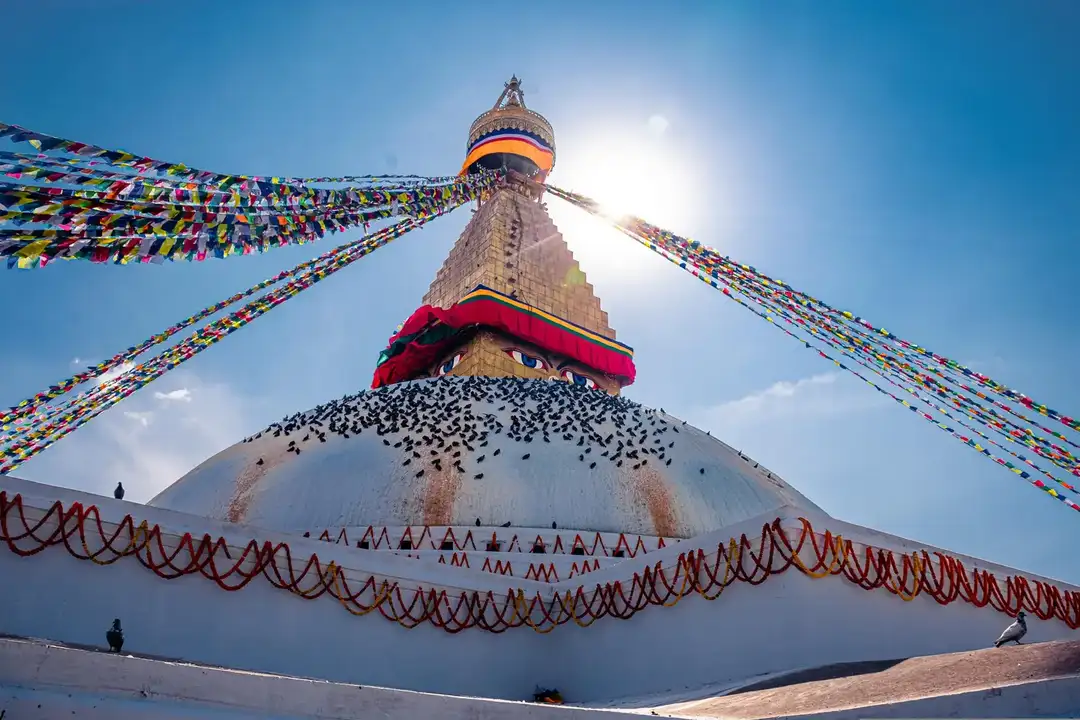
The scale of the stupa is impossible to truly convey in a photograph. It is monolithic. It is massive. The base is a series of three colossal, circular terraces, each intricately inlaid with 108 small niches housing diminutive statues of the Buddha. Above the terraces rises the great white dome itself, a perfect, immense hemisphere of whitewashed brick and mortar, symbolizing the womb of creation. It is so large that it alters the local microclimate; you can feel the cool shadow it casts long before you step beneath it.
Crowning the dome is the harmika, a squared, gilded tower, and atop that, a towering, gilded spire adorned with the thirteen steps representing the thirteen stages on the path to enlightenment. At the very pinnacle, the gilded parasol catches the harsh Nepali sun, blazing like a second sun.
The Eyes That Strip the Ego
But it is the eyes that capture you. Painted on all four sides of the golden harmika, beneath a curling question mark that represents the Nepali numeral for "one" (symbolizing the unity of all things), is a pair of immense, heavily outlined eyes. They are the Eyes of the Buddha, gazing out serenely over the valley in the four cardinal directions. When you first lock eyes with the stupa, the sensation is visceral. They are not aggressive, nor are they passive. They are profoundly, unsettlingly calm. It feels less like you are looking at a piece of art, and more like a silent, all-knowing consciousness is looking directly through you, stripping away your anxieties and your ego, leaving you feeling utterly transparent.
Yet, for all its architectural majesty, the true magic of Boudhanath lies in its human element. The stupa is the epicenter of Tibetan Buddhism in exile, and the plaza surrounding it is an ocean of perpetual, hypnotic motion.
From dawn until long past dusk, a river of humanity flows around the base of the great dome in a continuous, clockwise circumambulation known as a kora. It is a moving meditation that never stops. You join the current, and you are immediately swept up in a rhythm that feels older than time.
"It feels less like you are looking at a piece of art, and more like a silent, all-knowing consciousness is looking directly through you..."
The River of Humanity
The demographic of the kora is a beautiful, chaotic tapestry. You walk shoulder to shoulder with scarlet-robed monks and nuns, their faces illuminated by the glow of their smartphones even as their lips move in silent mantra. You pass elderly Tibetan refugees, their faces deeply lined maps of a difficult history, spinning brass prayer wheels in their weathered hands, the mechanical clicking blending into a collective hum. You walk past young Nepali couples holding hands, wide-eyed Western backpackers trying to find their center, and local merchants taking a break from their shops to spin a few rounds for good karma.
Occasionally, someone will drop to the ground, sliding forward on wooden handguards to perform a full-body prostration, measuring the circumference of the stupa with their own flesh and bone. It is an act of such extreme devotion and physical endurance that it silences the internal chatter of your own mind.
This human river is accompanied by a soundtrack that is uniquely Boudhanath. The air is constantly thick with the smell of burning juniper and sage, wafting from giant incense burners placed at the base of the dome. The rhythmic clacking of hundreds of prayer wheels being spun mingles with the low, guttural murmuring of the Om Mani Padme Hum mantra.
The Sound of the Eternal
But as the afternoon deepens into dusk, a new sound rises from the monasteries that ring the perimeter of the plaza. It begins as a low, resonant vibration, like the humming of a giant cello. It is the sound of Tibetan monks chanting their evening prayers. The deep, throat-singing resonates through the ground, echoing off the white-washed walls of the stupa. It is a sound that bypasses your ears and vibrates directly in your chest cavity. It is a primordial, ancient sound that makes the hair on your back stand up. It is the acoustic equivalent of the stupa’s visual weight—heavy, grounding, and eternal.
In 2015, when a devastating 7.8 magnitude earthquake struck Nepal, the world watched in horror as centuries-old heritage sites crumbled to dust in the Kathmandu Valley. Boudhanath was severely damaged. The spire cracked, the golden canopy tilted precariously, and chunks of the great white dome fell to the plaza below. For a terrifying moment, it seemed the heart of Tibetan exile had been broken.
But the response to the destruction was a profound testament to the resilience of the community. The stupa was not rebuilt by a distant government agency; it was rebuilt by the people. Monks carried bricks in their robes. Local shopkeepers donated their daily earnings. Exiled Tibetans who had lost their homes sent what little they could in a staggering display of devotion. Today, Boudhanath stands stronger than ever, its pristine geometry fully restored, serving as an indestructible beacon of hope, resilience, and spiritual endurance.
Expedition Essentials
Dusk is Magic: While beautiful at dawn, arriving at dusk when thousands of butter lamps are lit and the hypnotic evening throat-singing begins at the monasteries is a transformative experience.
The Kora Rules: Always walk around the stupa in a clockwise direction. If you spin the prayer wheels, use your right hand.